
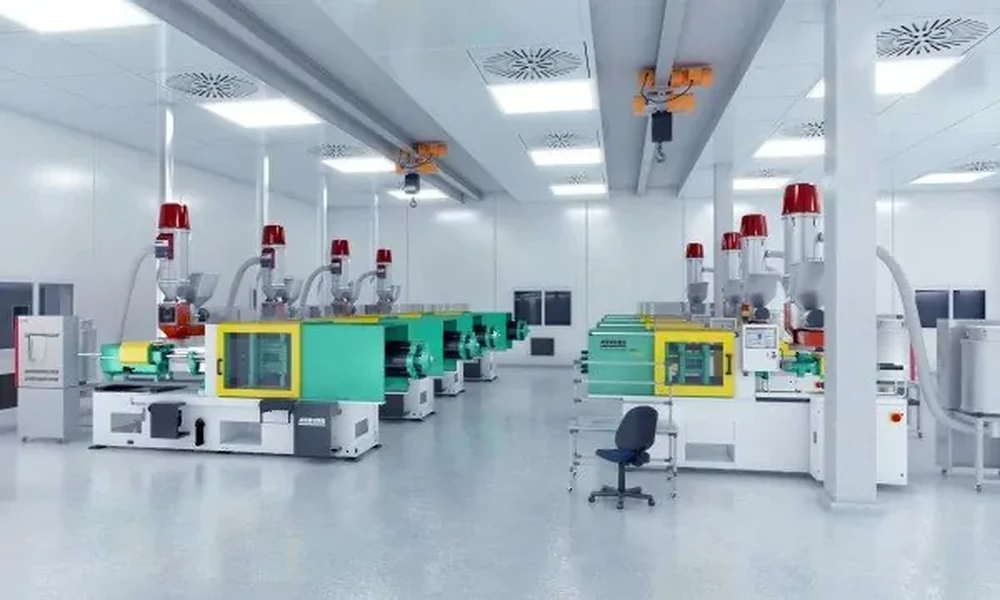
Clean room injection molding is the production of plastic components by injection molding within a classified clean room environment. The process combines the high-volume production economics and geometric capability of plastic injection molding with the contamination control required for components that will be used in medical devices, pharmaceutical packaging, in vitro diagnostics, or other healthcare applications where particle and microbial contamination of the finished component cannot be tolerated.
Why the Clean Room Matters in Plastic Injection Molding
Standard plastic injection molding takes place in factory environments where airborne particles, machine lubricants, and incidental contamination are present at levels that are acceptable for general industrial products but not for healthcare components. A component that will be used in a single-use surgical device or packaged with a sterile pharmaceutical product must meet contamination limits that a standard factory environment cannot guarantee.
Clean room injection molding controls the environment in which both the injection process and any post-moulding operations take place. HEPA-filtered air at positive pressure relative to surrounding areas suppresses particle counts. Gowning protocols for operators reduce the human contribution to contamination. Environmental monitoring confirms that the clean room is performing within its classified parameters throughout the production run.
ISO Classification for Clean Room Injection Molding
The ISO 14644-1 classification used for clean room injection molding depends on the contamination sensitivity of the component and the regulatory requirements of the product it will be used in. ISO Class 7 and ISO Class 8 are the most common classifications for medical device plastic injection molding. ISO Class 8 is typically used for components that will be further sterilised after assembly; ISO Class 7 for more sensitive applications.
The classification must be validated through particle counting at production conditions, not just in static at-rest conditions, and maintained through ongoing environmental monitoring.
Materials in Clean Room Injection Molding
Medical device and healthcare applications use a range of engineering polymers in clean room injection molding. The material choices are driven by the mechanical properties, chemical resistance, and biocompatibility requirements of the application.
Polycarbonate is used for transparent components where optical clarity is important. Polypropylene is widely used for single-use components due to its low cost, chemical resistance, and compatibility with gamma and ethylene oxide sterilisation. ABS and nylon are used for device housings and structural components. PEEK is used in applications requiring high strength, temperature resistance, and biocompatibility in demanding environments.
“In healthcare manufacturing, the standard is set by the most vulnerable patient, not the average case,” said former HSA chief executive Tan Chorh Chuan. Clean room plastic injection molding applies that standard to the production of every component.
Tool Design and Maintenance for Clean Room Production
Injection moulds used in clean room production must be maintained to avoid contamination from mould lubricants, rust inhibitors, or degrading mould surface coatings. Clean room-compatible lubricants and regular scheduled maintenance of the mould reduce the risk of contamination events from the tooling itself.
Mould design for clean room production also considers the ease of validation and the minimisation of potential contamination points. Multi-cavity moulds increase throughput but require that all cavities produce conforming parts consistently.
AMT Clean Room Injection Molding
AMT provides clean room injection molding for medical and healthcare components at ISO 14644-1 classified environments appropriate for the applications involved. Their quality management system, certified to ISO 13485, covers the environmental monitoring, process control, and documentation requirements for regulated medical device plastic component manufacturing.